


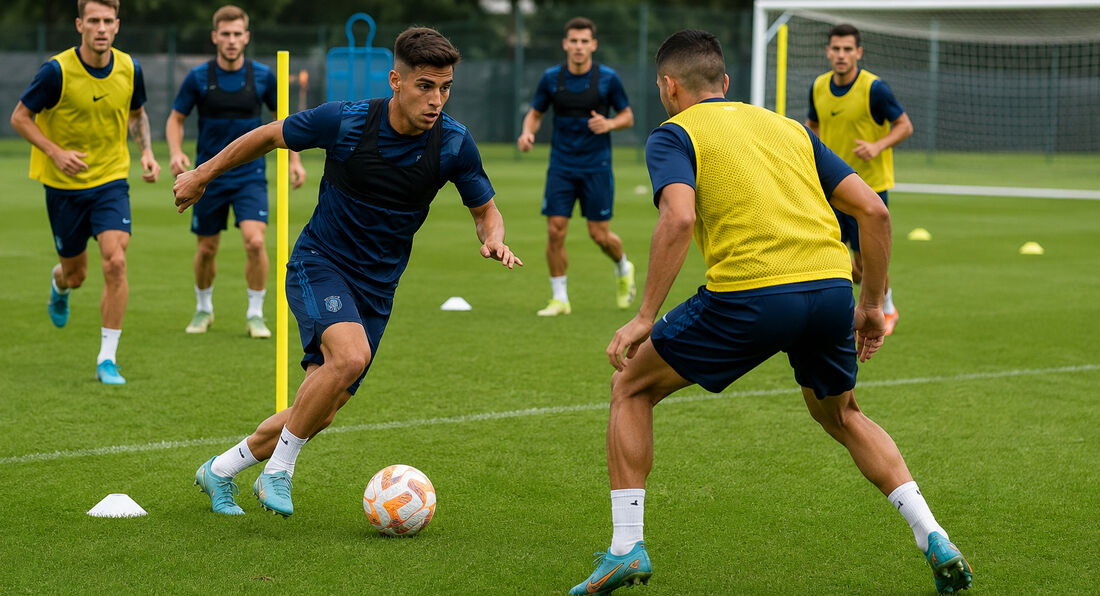
Football is no longer a game won purely by talent. Modern footballers are faster, stronger, fitter and more athletic than ever before. Whether you play professionally, semi-professionally or simply want to dominate your local league, your success depends on what you do both on and off the pitch.
The best footballers combine four key elements:
• Technical football training
• Strength and gym work
• Outdoor conditioning and speed work
• Elite nutrition and recovery
Neglect any one of these and your progress will be limited.
Football Training on the Pitch
The pitch is where football-specific fitness is developed. Many players make the mistake of simply playing matches and expecting to improve. The best players spend time deliberately practising specific skills.
Focus on:
Ball Control
Every touch matters. Spend time each week working on first touch, receiving under pressure, close control and dribbling. Simple wall passing drills remain one of the most effective exercises ever created for footballers.
Passing
Football is fundamentally a passing game.
Train:
- Short passing
- Long passing
- One-touch passing
- Passing under pressure
- Weak foot passing
The best midfielders in the world often spend hundreds of repetitions each week refining passing accuracy.
Shooting
Power is important, but placement wins matches.
Practise:
- Finishing with both feet
- First-time shots
- Volleys
- Curled finishes
- One-on-one situations
Train game scenarios rather than simply blasting balls at goal.
Small-Sided Games
Small-sided games improve:
- Decision making
- Fitness
- Awareness
- Technical ability
- Match sharpness
Many elite academies consider 5v5 and 7v7 games among the most valuable forms of football training.
Gym Training for Football
Gone are the days when footballers avoided the gym. The modern game rewards strength, power and athleticism. The goal is not bodybuilding. The goal is becoming a stronger, faster and more explosive footballer.
The Best Lower Body Exercises
Squats
Squats develop:
- Leg strength
- Sprint power
- Jumping ability
- Overall athleticism
Both back squats and front squats are excellent choices.
Romanian Deadlifts
These strengthen the posterior chain:
- Hamstrings
- Glutes
- Lower back
Strong hamstrings are essential for sprinting and injury prevention.
Bulgarian Split Squats
Football is largely played on one leg at a time.
Bulgarian split squats improve:
- Balance
- Stability
- Single-leg strength
- Injury resilience
Walking Lunges
One of the best exercises for developing football-specific leg strength.
Upper Body Training
Footballers should not neglect the upper body.
A stronger upper body improves:
- Shielding the ball
- Physical battles
- Balance
- Injury resistance
Focus on:
- Pull-ups
- Rows
- Bench press
- Push-ups
- Shoulder presses
Core Training
A powerful core improves every movement on the pitch.
Train:
- Planks
- Side planks
- Hanging leg raises
- Cable rotations
- Pallof presses
The core transfers power between the upper and lower body.
Outdoor Conditioning and Speed Training
Many footballers spend too much time jogging and not enough time sprinting. Football is a sprint-based sport. Elite players repeatedly accelerate, decelerate and change direction.
Sprint Training
Train:
- 10 metre sprints
- 20 metre sprints
- 30 metre sprints
- Flying sprints
Always prioritise quality over quantity.
Maximum effort is essential.
Acceleration Work
Most football sprints are under 20 metres.
Practise explosive starts from:
- Standing positions
- Lying positions
- Split stances
- Reactive starts
Agility Training
Football requires rapid changes of direction.
Use:
- Cone drills
- Shuttle runs
- Zig-zag runs
- Reactive movement drills
Football Conditioning
Instead of endless long-distance running, focus on football-specific intervals.
Example:
Sprint 20 seconds
Walk 40 seconds
Repeat 15-20 times
This better replicates match demands.
Plyometric Training
Plyometrics increase explosive power.
Examples include:
- Box jumps
- Broad jumps
- Bounds
- Single-leg hops
- Depth jumps
These exercises improve sprint speed and jumping ability.
Recovery: The Secret Weapon
Many players train hard but recover poorly. Improvement occurs during recovery.
Prioritise:
- 8-9 hours sleep
- Proper hydration
- Mobility work
- Stretching
- Massage
- Rest days
Poor recovery leads to poor performance.
Football Nutrition
You cannot out-train a bad diet. Nutrition fuels performance, recovery and body composition.
Protein
Protein repairs muscle tissue and supports recovery. Aim to consume protein with every meal.
Good sources include:
- Chicken
- Turkey
- Lean beef
- Eggs
- Fish
- Greek yoghurt
- Protein shakes
Carbohydrates
Carbohydrates are the primary fuel for football. The best footballers do not fear carbohydrates.
Focus on:
- Rice
- Potatoes
- Oats
- Wholegrain pasta
- Fruit
- Vegetables
Increase carbohydrate intake around training and matches.
Healthy Fats
Fats support hormone production and overall health.
Sources include:
- Olive oil
- Nuts
- Seeds
- Avocados
- Oily fish
Hydration
Even mild dehydration reduces performance. Drink regularly throughout the day. Monitor urine colour. Pale straw colour generally indicates good hydration.
Pre-Match Nutrition
Three to four hours before kick-off:
- Lean protein
- Moderate carbohydrates
- Low fat
- Easy-to-digest foods
Examples:
- Chicken and rice
- Turkey sandwich
- Oats with fruit
Post-Match Nutrition
Within two hours:
- Protein for recovery
- Carbohydrates for glycogen replenishment
- Plenty of fluids
This accelerates recovery and prepares the body for the next session.
The Ideal Weekly Football Training Plan
Monday:
Strength training (lower body) + technical work
Tuesday:
Speed training + football practice
Wednesday:
Recovery and mobility
Thursday:
Strength training (full body) + football training
Friday:
Light technical session and set pieces
Saturday:
Match day
Sunday:
Recovery walk, stretching and mobility
The best football training programme combines technical skill development, intelligent gym work, explosive speed training, football-specific conditioning and elite nutrition. The players who improve the fastest are not necessarily the most talented. They are the most consistent. Master the fundamentals. Train with purpose. Recover properly. Fuel your body with quality nutrition. Do these things consistently and you will become stronger, faster, fitter and more effective on the football pitch than ever before.


