


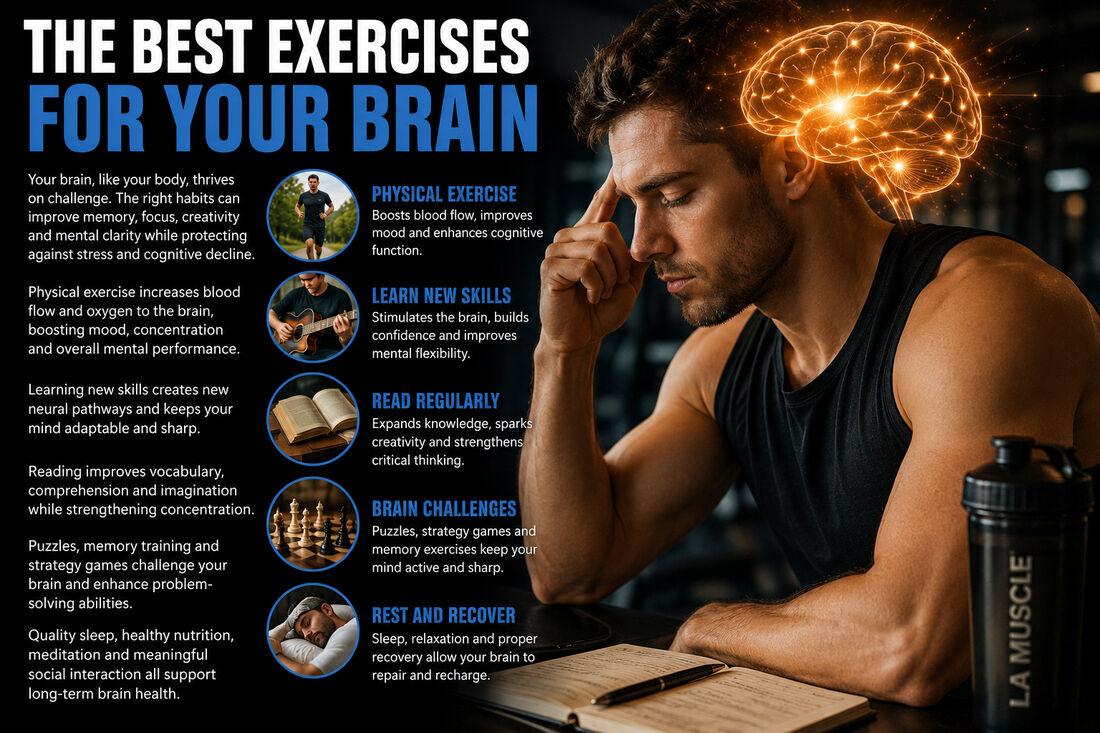
When people think about exercise, they usually think about building bigger muscles, burning fat, improving fitness, or increasing strength. However, some of the greatest benefits of exercise occur inside your head.
Your brain is like a muscle. The more you challenge it, the stronger, faster, and more efficient it becomes. Just as physical exercise improves the body, mental exercise helps improve memory, concentration, creativity, problem-solving ability, learning capacity, and mental resilience.
The good news is that you do not need expensive equipment or hours of study to keep your brain sharp. Small daily habits can significantly improve brain performance over time.
Physical Exercise
Perhaps surprisingly, one of the best exercises for your brain is actual physical exercise.
When you exercise, blood flow to the brain increases. More oxygen and nutrients reach brain cells, helping support memory, focus, learning, and mental performance.
Activities such as:
- Walking
- Running
- Cycling
- Swimming
- Resistance training
- Team sports
have all been associated with improved cognitive function.
Even a 20-minute brisk walk can boost concentration and mental clarity.
Learning a New Skill
Nothing stimulates the brain quite like learning something completely new.
When you challenge yourself to acquire a new skill, your brain forms new neural pathways and strengthens existing connections.
Examples include:
- Learning a language
- Playing a musical instrument
- Photography
- Coding
- Cooking
- Public speaking
- Dancing
The more unfamiliar the skill, the harder the brain must work, leading to greater mental development.
Reading
Reading remains one of the most effective brain exercises available.
Books require imagination, concentration, memory, and comprehension.
Unlike scrolling social media, reading forces the brain to process information in depth.
Reading regularly can improve:
- Vocabulary
- Knowledge
- Memory
- Critical thinking
- Creativity
Even just 20 minutes per day can produce long-term benefits.
Strength Training
Resistance training is not only beneficial for muscles. Studies have repeatedly shown that strength training can support brain health, concentration, mood, and mental performance. Training with weights requires coordination, focus, balance, and motor control, all of which challenge the brain while simultaneously strengthening the body. This is another reason why progressive overload benefits both physical and mental development.
Memory Training
Memory can be improved through practice.
Simple memory exercises include:
- Memorising shopping lists
- Remembering phone numbers
- Learning quotations
- Recalling names and faces
- Using memory palace techniques
Like any skill, memory improves when it is regularly challenged.
Puzzles and Brain Games
Activities that force the brain to solve problems can help maintain mental sharpness.
Examples include:
- Chess
- Sudoku
- Crosswords
- Logic puzzles
- Strategy games
- Word games
These activities encourage pattern recognition, strategic thinking, concentration, and decision-making.
Learning Music
Music is often described as one of the most complete brain workouts available.
Learning an instrument simultaneously engages:
- Memory
- Timing
- Coordination
- Listening skills
- Fine motor control
- Creativity
Many musicians show exceptional connectivity between different regions of the brain because of years of musical training.
Meditation
Many people assume meditation involves doing nothing. In reality, meditation is active training for attention and awareness.
Regular meditation can help improve:
- Focus
- Emotional control
- Stress management
- Self-awareness
- Mental clarity
Even five to ten minutes per day can produce noticeable improvements.
Social Interaction
Conversation is one of the most underrated brain exercises.
Engaging with other people requires:
- Listening
- Memory
- Emotional intelligence
- Language processing
- Quick thinking
Meaningful conversations challenge the brain in ways that passive entertainment often cannot.
Writing
Writing forces thoughts into organised structures.
Whether journalling, blogging, writing stories, or taking notes, writing engages numerous areas of the brain simultaneously.
Benefits include:
- Better memory retention
- Clearer thinking
- Improved communication skills
- Greater creativity
Many successful entrepreneurs, leaders, and thinkers maintain journals for this reason.
Learning Through Teaching
One of the most powerful ways to strengthen knowledge is to teach it. When you explain a concept to someone else, your brain must organise information, simplify ideas, and identify gaps in understanding. This process deepens learning and improves long-term retention. If you truly want to master a subject, teach it.
Sleep
While not technically an exercise, sleep may be the most important factor in brain performance.
During sleep the brain:
- Consolidates memories
- Repairs cells
- Processes information
- Clears waste products
- Supports learning
A tired brain simply cannot perform at its best. Prioritising quality sleep is one of the smartest investments you can make in your mental performance.
The Ultimate Brain Workout
If you wanted the perfect daily routine for brain development, it would include:
- Physical exercise
- Reading
- Learning something new
- Social interaction
- Mental challenges
- Quality sleep
The brain thrives on challenge, novelty, movement, and recovery. The best exercise for your brain is not a single activity. It is a combination of physical movement, continuous learning, mental stimulation, and healthy lifestyle habits. Just as muscles grow stronger when challenged, the brain becomes sharper when it is regularly pushed beyond its comfort zone. Read more. Learn more. Move more. Think more. Your brain is capable of remarkable growth throughout your entire life, but only if you continue to give it reasons to adapt.


